Showing posts with label light bulb. Show all posts

Friday, March 7, 2014

Go Green with Green Alternatives to Everyday Products...


Although you can't single-handedly clean up the environment, you can make choices in your everyday life that will benefit the health of the planet and your community. Simple changes, such as finding green alternatives for the everyday products you consume, can have a beneficial impact on water quality, energy use and the amount of pollution and waste you generate.


Personal Care Products

Everyday products such as soaps, toothpastes, cosmetics and hair care items, often contain chemicals that, when washed off during showers and baths, enter the waste-water stream and can pollute the waterways. When purchasing personal care items, read labels carefully. Products with "natural," organic" or "hypoallergenic," on the labels can be misleading, since there little regulation on the use of these terms. Look for products that list fewer ingredients, and ingredients with names that can be pronounced. Green alternatives include avoiding products with synthetic fragrances, and trying to use fewer personal care products overall. (See Reference 1) You can even make many of your own personal care products with natural ingredients. For example, substitute natural, oil-based soaps for commercial shampoos and rinse your hair with plain cider vinegar. Make your own lotions from essential oils and other natural ingredients, such as aloe vera, shea butter and jojoba.

Home Cleaning Products

Homes now contain up to 10 times more pollution than is found outdoors, much of it from the use of cleaning products. In addition to the health risks, these chemical cleaners also harm the environment in their manufacture, use and disposal. (See Reference 2.) Green alternatives to chemical cleaning products are often found in the kitchen. For example, the U.S. EPA's guide to safer cleaning recommends using 4 tablespoons of baking soda to one quart of water for an all-purpose kitchen and bath cleaner. Substitute 2 tablespoons of baking soda and 2 tablespoons of borax for automatic dishwasher soap. To clean carpets, sprinkle with a mixture of 1 cup of borax and 2 cups of cornmeal, and allow it to stand an hour before vacuuming. Clean hard-surface floors with 1/2 cup of white vinegar in 1/2 gallon of water. (See Reference 3.)

Disposable Paper Goods

Paper and cardboard make up almost 33 percent of solid wastes in landfills, according to the U.S. Environmental Protection Agency. (See Reference 4.) Cut down on your landfill contribution with greener options for everyday paper products. Opt for cloth napkins over paper napkins, and substitute washable plates and cups for disposable ones. Instead of using paper towels, wipe up spills with re-usable cleaning cloths, and dry windows with clean, lint-free cloths that can be laundered. Carry your work or school lunches in fabric bags rather than disposable paper brown bags. Buy recycled copy paper instead of new, and then use both sides before shredding it and adding it to your compost pile. Instead of buying note pads and drawing paper for children, save junk mail for jotting down notes and paper craft projects.

Food Products

Much of the food Americans eat each day is grown, processed and packaged long distances from their homes. For example, produce may travel as much as 1,500 miles from grower to table. (See Reference 5.) Long “food miles” contribute to fossil-fuel use and greenhouse gas emissions. Green options for many of your everyday grocery store purchases include buying local food whenever possible, shopping farmers’ markets and eating vegetables and fruit when in season. You may be able to shop for beef, free-range chicken and dairy products from growers in your area as well. Organizations such as Local Harvest provide searchable databases for each state and city in the U.S. to help your find nearby food resources in your community and to help you reduce your own "food miles." (See Reference 6).


Wednesday, March 20, 2013

Simple Actions to save Energy and Go Green


One Change leads to another. When it comes to saving money and cutting your hydro bill, switching to energy efficiency light bulbs is just the start. Here are some more simple actions to help you conserve energy and save money.
Replace your old-fashioned incandescent light bulbs with energy-saving CFL bulbs
Replace your old-fashioned incandescent light bulbs with energy-saving CFL and LED bulbs
Compact fluorescent light (CFL) and LED bulbs use about 75% less energy than old-fashioned incandescent light bulbs and last much longer. For every bulb you swap, you can cut greenhouse gas emissions and save money on your energy bill over the lifetime of the bulb. Click here for information on CFL recycling in North America.
Plug your electronics into power strips and shut them off when not in use
Fight what’s known as phantom or vampire power. Your computer, printer, TV, DVD player, stereo, kitchen appliances and other electronics are still sucking power while you have them shut off. In North America, 75% of the electricity used to power home electronics and appliances is consumed while the products are turned off! Switching them off with a power strip when you’re not using them will cut all power to the appliances and save you loads of money on wasted energy—as much as 15% of your monthly bill!
Stay cool with a ceiling fan
Instead of A/C consider installing an ENERGY STAR-qualified ceiling fan, which can cost as little as 10 cents a month in energy. You can even save money in the winter. Reverse the direction of your ceiling fan motor so that cool air is pushed up towards the ceiling, drawing warm air down into the room. Rather than cold floors and warm ceilings, you’ll have a more even temperature throughout the room. Now, can your air conditioner do that?
Install a programmable thermostat and lower it
Install a programmable thermostat to lower your heat when you don’t need it, for example when you’re out of the house and you could save up to $65 a year. Turning the thermostat down just 1 degree C can save you 2% on your heating bill.
The Dishwasher
Run a Full Dishwasher
By using an ENERGY STAR qualified dishwasher, running it when it’s full, and using an economy setting helps reduce the amount of hot water and energy used to clean your dishes. As much as 80% of the energy your dishwasher uses goes to heat water. So the less hot water you use to wash your dishes, the more energy and money you save. For an additional 10% energy savings, select the no-heat dry cycle (or simply open the door) to air dry your dishes.
Install low-flow showerheads and faucet aerators
Get an adequate flow for less dough! Installing low-flow showerheads and low-flow aerators on your kitchen and bathroom faucets is the single most effective water conservation action you can do for your home. Inexpensive and simple to install, low-flow shower heads and faucet aerators can reduce your home water consumption as much as 50%, and reduce your energy cost of heating the water also by as much as 50%. You likely won’t even notice a drop in water pressure—just in your water and energy bills (to the tune of over $150 a year)!
Air dry your laundry
Did you know that your clothes dryer is the second biggest electricity-using appliance in your home (after the refrigerator)? Why not air dry your cloths on a clothesline or drying rack to save as much as $100 on your electricity bill each year.

Wash your laundry in cold water
85 – 90% of the energy used to wash your clothes is used to heat the water, so why not switch to cold to save money and energy. While you’re at it, wait until you have a full load before starting the washing machine.


Source: http://www.onechange.org

Canadian trio invent ‘most energy-efficient’ light bulb


There’s a new energy efficient lightbulb making waves, and not only was it invented by Canadians, but it’s about the funkiest looking illumination device we’ve seen since the lava lamp.
Introducing the Nanolight.
The flashy device promises to produce as much light a 100-watt incandescent bulb while using only an eighth of the power, reports the CBC.

Its makers are three University of Toronto graduates, and they took to crowdfunding website Kickstarter to get the project off the ground. Gimmy Chu, Tom Rodinger, Christian Yan, who all met at a solar car-building competition in 2005, were hoping to raise a paltry $20,000. They quickly blew past that marker and are currently sitting on $141,911 in pledges after less than a month of fundraising.

Make no mistake — these bulbs aren’t cheap. A $30 donation will get you a single 10 watt bulb, while a $45 will get you the 12 watt model. But NanoLight’s makers promise that users will quickly earn back that initial investment in electricity savings. The blub will last for 25-30 years based on three hours a day usage.

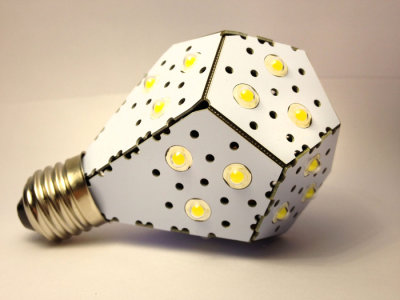
The NanoLight's genius is in its complex circuit board design, which is implanted with numerous tiny LED lights facing in different directions.

(Credit: Nanolight)


According to its makers, the NanoLight is superior to the current energy efficient LED lights on the market for a number of reasons.

For one, it lights in all directions, something current LED lights cannot do. It also produces the equivalent of 100 watts of light, something that is still relatively rare among LED lights. The Nano Light is also reportedly one of the coolest on the market, in that it won’t overheat when used in an enclosed fixture the way many other LED bulbs will.

Those interested in getting their paws on the first generation of these groundbreaking new bulbs need look no further than NanoLight’s Kickstarter page, which will be accepting pledges until Friday, March 8, 2013.

Source: http://ca.shine.yahoo.com