Showing posts with label Humans. Show all posts

Wednesday, March 20, 2013

Canadian trio invent ‘most energy-efficient’ light bulb


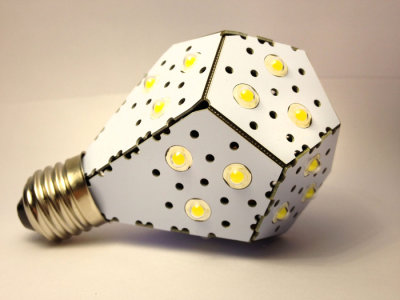
There’s a new energy efficient lightbulb making waves, and not only was it invented by Canadians, but it’s about the funkiest looking illumination device we’ve seen since the lava lamp.
Introducing the Nanolight.
The flashy device promises to produce as much light a 100-watt incandescent bulb while using only an eighth of the power, reports the CBC.

Its makers are three University of Toronto graduates, and they took to crowdfunding website Kickstarter to get the project off the ground. Gimmy Chu, Tom Rodinger, Christian Yan, who all met at a solar car-building competition in 2005, were hoping to raise a paltry $20,000. They quickly blew past that marker and are currently sitting on $141,911 in pledges after less than a month of fundraising.

Make no mistake — these bulbs aren’t cheap. A $30 donation will get you a single 10 watt bulb, while a $45 will get you the 12 watt model. But NanoLight’s makers promise that users will quickly earn back that initial investment in electricity savings. The blub will last for 25-30 years based on three hours a day usage.

The NanoLight's genius is in its complex circuit board design, which is implanted with numerous tiny LED lights facing in different directions.

(Credit: Nanolight)


According to its makers, the NanoLight is superior to the current energy efficient LED lights on the market for a number of reasons.

For one, it lights in all directions, something current LED lights cannot do. It also produces the equivalent of 100 watts of light, something that is still relatively rare among LED lights. The Nano Light is also reportedly one of the coolest on the market, in that it won’t overheat when used in an enclosed fixture the way many other LED bulbs will.

Those interested in getting their paws on the first generation of these groundbreaking new bulbs need look no further than NanoLight’s Kickstarter page, which will be accepting pledges until Friday, March 8, 2013.

Source: http://ca.shine.yahoo.com


Tuesday, February 5, 2013

10 Organizations That Will Green Your World


The Nobel Prize for sustainability? That's what Katerva sells itself as: it's a new and important awards organization which scours the globe for people and organizations that can make real, immediate change for our planet. Now Katerva has announced its 10 winners for the Katerva Awards 2012. In 2011 I wrote about Katerva's 8 finalist projects that will save planet earth (including this eco-toilet) and today I am helping Katerva announce its 10 winners for 2012.
katerva sustainable awards nobel prize ecology

Terry Waghorn, who established the organization, spends his days and nights networking and Skyping with high-ranking authorities across the globe, from celebs, princesses, supermodels, entrepreneurs and universities to techies at their hubs. Oh, and once and a while, me. Unlike TED events (see the TEDx I helped organized in Jaffa) which bring together important and inspiring people to talk, Katerva is a catalyst that aims to put talk into serious action.
According to Waghorn, "Today's unprecedented challenges require a new kind of organization, one that optimizes the world's unprecedented interconnectedness, prioritizes action and systematically taps the most innovative ideas on the planet. Katerva is that organization: designed to convene, catalyze and accelerate breakthrough solutions to global challenges."
Winners (posted below, including the grand prize winner for a micro-implantable vaccine delivery device) will be fostered through development stages by members of Katerva -- people, businesses and committed experts. Read on for the list of who wins support from Katerva. These are organizations that should be on every humanitarian funders' e-roladex, and obviously they are great starts for interns and volunteers. Simply by sharing this post you can help support them.
And the winners are:
Bioneedle Technologies Group is the top winner of the 2012 Katerva Award. Bioneedles, "tiny, biodegradable mini-implants," come pre-filled and contain vaccines in a thermally stable environment. The Bioneedle Technologies Group is a project based in The Netherlands. Although this project is only in the ideation stage, this technology has the possibility to grant vaccine access to more people than ever before and increase the global population's immunity to infectious disease.
Safe World for Women: The Safeworld International Foundation is a women-led NGO working with grassroots groups to promote women's empowerment and sustainable development, tackle the root causes of poverty and oppression and bring positive social and economic change at a global level. It is registered in England and Wales.
¡Echale! a Tu Casa is an assisted self-build program that provides sustainable community development through social housing production. ¡Echale! a Tu Casa (put your heart into your home) is commissioned by the Mexican National Social Housing Production Program.
FOLDIT focuses on solving challenging biochemistry problems by building a symbiosis between computers and people through interaction with a video game. Foldit was developed by the University of Washington.
Water.org's WaterCredit puts microfinance tools to work in the water and sanitation (watsan) sector. WaterCredit is the first comprehensive program of its kind that connects the microfinance and watsan communities to scale up access to credit for individual- and household-based watsan needs. Water.org is a worldwide project based in the U.S. with staff in the U.S., India and Kenya.
Reef Check is the world's largest reef monitoring network. The Reef Check Foundation is a nonprofit that started in Southern California in 1996 with a mission to empower local communities through grassroots research, conservation and education to protect and rehabilitate reefs worldwide.
Center for Rice Husk Energy Technology: Discarded in heaps along roadsides and riverbanks, rice husks are considered waste in many countries heavily dependent on rice as a staple product. However, the Center for Rice Husk Energy Technology (CRHET) is challenging this notion by creating a rice husk gasifier stove that uses rice husks to provide clean and low-cost fuel. Gas produced from just one kilogram of husk can generate an equivalent of 1,920 kilocalories of energy. The CRHET is an office at the CPU College of Agriculture, Resources and Environmental Sciences in the Philippines.
The Backpack Farm Agricultural Program in Kenya is an internationally recognized social enterprise aggregating packages of "green" farming inputs and conservation training exclusively to smallholder "commercial" farmers with 2 to 5 acres of land earning their primary income from horticulture production.
The Pasteurization Technology Group seeks to revolutionize the disinfection of wastewater using a patented "two-for-one" technology, eliminating toxic chemicals and intensive electricity usage in the process. Based in California, it has partnerships in North America, Asia and South America.
Mitsubishi Air Lubrication System for Shipping, developed by the Mitsubishi Heavy Industries Corporation in Japan, is a technology designed to reduce the skin-friction resistance on the hull of a ship by sending air to the bottom of the hull to create a layer of air bubbles between the hull and seawater. This makes shipping less polluting and more efficient.
The Agua Clara program is a research program at Cornell University that produces engineering design for reliable and sustainable municipal-scale water treatment plants. This means less contaminants entering our groundwater, seas and waterways and an easier way for cities and towns to deal with wastewater.

Source: huffingtonpost.com
Monday, February 4, 2013

From "Light Green" to Sustainable Buildings


As more people move to urban areas in search of economic opportunities, the number of buildings that are needed to house them continues to rise. It is estimated that by 2030, an additional 1.4 billion people will live in cities, of which 1.3 billion will dwell in cities of developing countries. The increasing number of buildings has long-term impacts on both the environment and natural resources. Fortunately, a variety of policy tools hold promise for promoting sustainability in buildings, according to Kaarin Taipale, contributing author of the Worldwatch Institute's State of the World 2012: Moving Toward Sustainable Prosperity.
 
The buildings in which we live and work are a major consumer of energy, responsible for some 30—40 percent of all carbon dioxide emissions, a similar share of total solid waste, and 12 percent of all fresh water used. With the rate of urbanization reaching record levels, there will be more construction and buildings than ever before.
The introduction and enforcement of effective public policies can be the cheapest and most efficient method for promoting sustainability in the construction and use of buildings, Taipale says. The goal is to radically reduce buildings' environmental footprint and long-term negative social and financial effects.
In search of a "best policy" in her State of the World 2012 chapter, "From Light Green to Sustainable Buildings," Taipale suggests considering four dimensions in a policy package:

Process. It is important to take into account the entire life-cycle of a building, from design and construction to its use and demolition. Some posit that designating a sustainability coordinator for the planning and construction period should be a requirement for any building permit. An additional tool for the time span when the building is being used is a mandatory "maintenance diary," documenting the various ways the building is serviced and renovated.

Performance. What matters most is how well the entire building performs, not how its individual parts might adhere to requirements. Setting minimum energy performance standards, for example, makes more sense than specifying the thickness of a thermal insulation. A growing set of core criteria has evolved by which to measure building performance in terms of resource use. These consider greenhouse gas emissions, energy and water use, and waste production, among others. Policies can require that certain minimum performance standards and benchmarks be met.

Sustainable Infrastructure. Buildings need efficient infrastructures that save resources and provide everyone equal access to basic services such as fresh water and sanitation, energy, communication, and public transport. The quality of these infrastructures determines the level of urban sustainability. National water legislation, for example, can help secure access to safe drinking water for urban residents for a fair price.

Resource Use. Sustainability of resource use considers financial, human, and natural resources. Shifting toward a greater reliance on renewable energy is the most efficient method to reduce carbon dioxide emissions and mitigate climate change. Such a shift also helps reduce local air pollution and health hazards. We need higher energy performance requirements for new construction and refurbishment, however, because it does not make much sense to waste renewable energy in buildings that are not energy efficient.d, by absorbing CO2, they help the global village, too.

Source: http://www.worldwatch.org

Sunday, April 24, 2011

10 simple ways to green your pet for Earth Day and Every Day


1. Prevent pet overpopulation
"Spay or neuter!" says Leslie H., and we agree. All pets have some environmental impact, but spaying and neutering keeps the pet population in check (and unwanted litters out of shelters).

2. Buy in bulk
Maria R. buys the biggest bags of pet food available. "That saves on gas back and forth to the store," she says. It also cuts down on packaging waste (and is easier on the wallet).

3. Scoop poop
Unscooped dog poop can pollute water and spread disease (read our article 10 Reasons to Scoop Your Dog's Poop). Facebook fan Mar Mar C. goes even further, composting her pet's waste. (Pet poop should be kept separate from the compost you put on your vegetable garden. Check out Cityfarmer.org's guide to making a dog waste composter.)

4. Buy reusable supplies
Kathryn H. housetrains her dogs with machine-washable puppy pads. One reusable pad, like this one at PETCO, can keep hundreds of disposable pads out of landfills -- and save you money in the long run.

5. Recycle what you can't reuse
Mary Kay G. makes sure to recycle dogfood cans -- but many other types of food have recyclable packaging, so be sure to check. Kat H. buys organic dog food that comes in recyclable bags. "Also it is locally made, so less pollution," she points out.

6. Use earth-friendly pooper scoopers
"I use biodegradable poop bags and, as a pet sitter, that's a lot of bags," says Kathy R. PETCO has a wide selection of biodegradable pooper scoopers. Reusing old paper bags works too.

7. Make your own pet toys
"My birds play with junk mail and cardboard boxes," says Janice R. Repurposing household items into toys can be fun for you and your pet, and cuts down on household waste. Need ideas? Check out the links at the end of this post.

8. Use eco-friendlier cat litter
"I use [corn-based] World's Best Cat Litter, which you can flush instead of having to use plastic bags to dispose of the waste," says Susan P. Many corn- and pine-based cat litters are flushable, and as Treehugger.com points out in How to Green Your Pet the clay in traditional litter is strip-mined. Worried your cat won't like a new litter? Set up a "litter cafeteria" so he can choose his favorite.

9. Harness cuddle power!
"We keep the heat really low, but warm up with dogs," says Catie K. "[It's] the true meaning of a 'three-dog night.' " Seconds Micah E.: "In the winter, I can turn the thermostat down because my pets love to snuggle."

10. Adopt a homeless pet
This brings us back to our No. 1 point: Pets, like humans, inevitably impact the environment. But buying from a pet store or breeder just encourages more breeding, while adopting a homeless pet doesn't add to the pet population. Pet adoption is the original green option!

Now think about this: Do you really do anything to make yourself or your pets more eco-friendly?

Source:  http://www.petfinder.com